Architecture · 3D Visualization · Technical Plans
Architect & Urban Planner — Zárate, Buenos Aires, Argentina
Professional Profile
Experienced in architectural design, 3D modelling and render production, technical documentation and construction drawings. I aim to develop my career in studios where I can contribute creativity, technical precision and visual storytelling.
Education
Universidad del Salvador
Architect & Urban Planner
2020 – 2026
Experience
Arquicentro — Jr. Architect
Jan 2024 – Nov 2025
CONICET–SIGEVA USAL
Researcher · 2024–2025
Software
SketchUp · AutoCAD
D5 Render · Enscape · Vray
Illustrator · Photoshop · InDesign
Languages
Spanish — native
English — B2
First Certificate in English
01 — Architecture
Graduation Project · 2024
Site
Route 154, La Pampa, Argentina. The building aligns with the highway as its primary axis, generating a north–south longitudinal spine that organises the entire proposal. The implantation steps into the terrain following the language of the Mesas — the flat-topped plateaus that define the pampa landscape — and opens towards the salt flats to the north.
Programme
Four prismatic volumes define two zones: to the east, the technical programme — hydrogen production (H₂), electrolysis, energy systems and metadata processing; to the west, scientific dissemination and social spaces. A transverse spine connects all four volumes, improving circulation and reinforcing the containment protocols for hydrogen and lithium brine analysis.
Ground floor plan — longitudinal axis
Structure & Roof
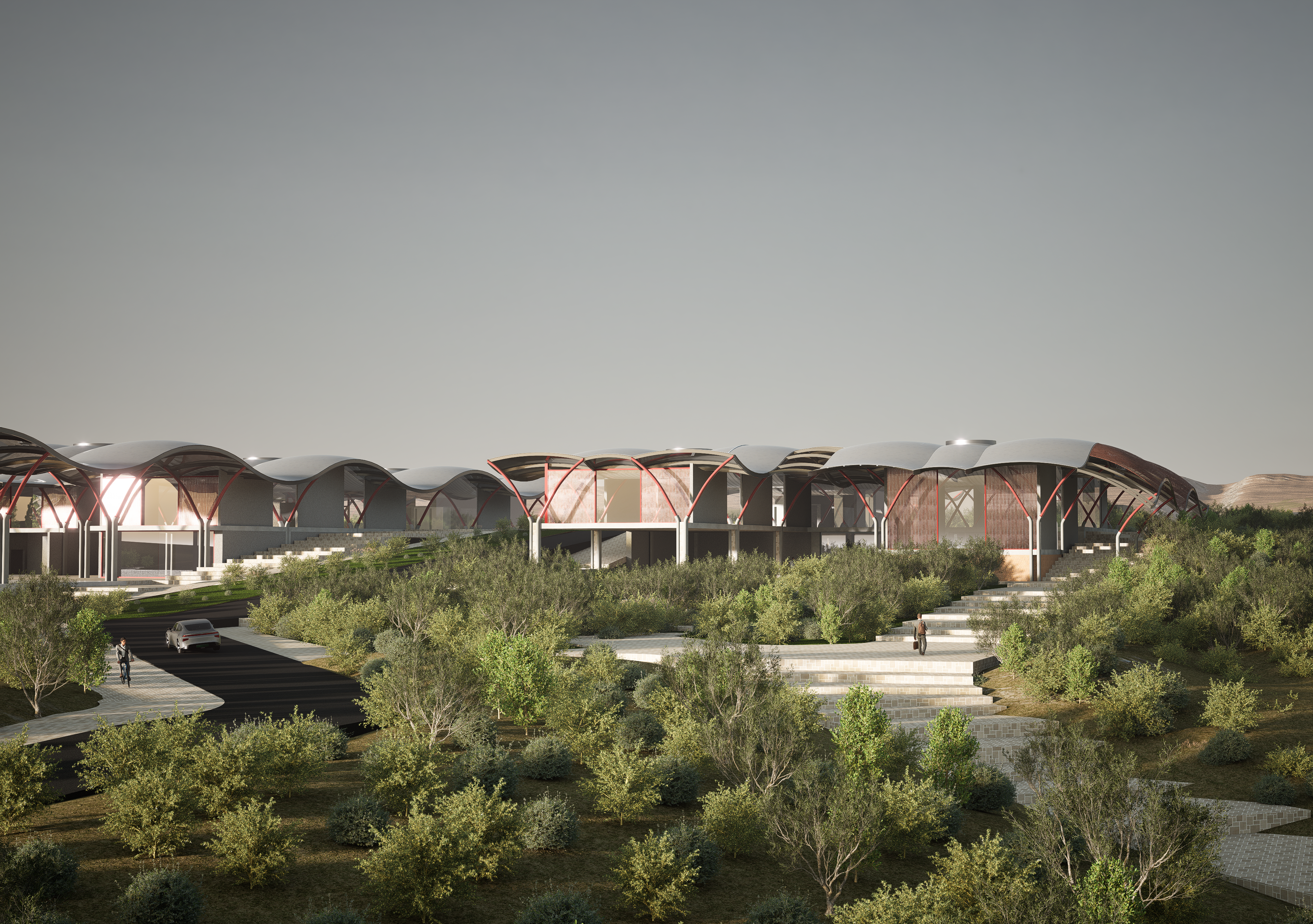
The gently curved roof draws its morphology from the geomorphology of La Pampa's Transverse Valleys. Separated from the building's envelope, the curve reduces the structure's perceived mass and opens the visual field at both entries. Large glazed panels are clad in perforated corten steel that filters direct solar radiation while maintaining visual permeability along the building's longitudinal axis.
Transverse spine — entry render
Materials
Perforated corten steel, structural glazing and an independent roof system. The curved roof also serves as a rainwater-harvesting surface, channelling water into storage tanks that feed a closed irrigation network to sustain vegetation at the building's entries through drip infiltration.
Interior courtyard
Architecture V · 2025
Site
Chilecito, La Rioja. The building is set into the arid Andean landscape, embedding the programme in the topography to exploit thermal inertia and minimise visual impact.
Site plan
Plan & Programme
Classrooms, community multi-purpose hall, library, administration and integrated outdoor spaces. The linear organisation maximises sunlight and cross-ventilation.
Planta Nivel +0.00
Sections & Sun Study
The sections reveal the relationship between the curved roof and solar rays at different times of year. The design controls light entry to ensure thermal comfort in an extreme climate.
Cortes A-A / B-B / C-C
Form & Technique
A curved metal-sheet roof emerging from the ground. Lightweight steel structure contrasted with brick and local stone walls. The multi-purpose hall is independently accessible.
Acceso principal
Architecture VI · 2023
Urban Scale
Agronomía, Buenos Aires. The project redefines the boundary between the institutional Agronomía campus and the Rawson residential neighbourhood, inserting a new urban piece that acts as connector between the two fabrics. Two main fronts face Av. San Martín and Zamudio, articulated by a sequence of courtyards, passages and interior voids.
Plan urbano — manzana
Site Plan
The San Martín front acts as an active urban edge, with a rhythmic facade of exposed columns and planes that generate depth through light and shadow. The Zamudio volume is conceived as a permeable piece housing a public library passage, student residences and collaborative workspaces, with vegetation as central mediator between programmes.
Planta de implantación 1:200
Typological Layout
The structural language is expressive and legible: columns, slabs and vertical planes clearly reveal the construction logic, generating rhythm through light and shadow. Columns partially wrapped by slab edges create vertical continuity between levels and reinforce the building's proportional system, based on the root-11 rectangle.
Planta Nivel +20.8 mts
Urban Variants
Three urban variants were studied for different sites within the neighbourhood — on San Martín, Melinué and Zamudio streets — each adapting the ensemble's orientation, density and facade language to the specific character of the surrounding context.
Architecture III · 2021
Concept
Pilar, Buenos Aires. The project is conceived around the idea of openness and continuity between architecture and the natural environment. Inclined roof planes unfold following the lateral tree canopy, directing views towards the landscape and establishing a dialogue between built form and the surrounding vegetation.
Maqueta — partido
Programme
The library is organised as a gradual spatial sequence — from the public entrance to progressively more intimate areas — articulating reading rooms, workshops and circulation under a unified architectural language. The spatial progression guides users through different levels of privacy and concentration.
Form & Structure
A wooden column structure evokes the materiality and verticality of the surrounding forest, generating a structural rhythm that combines tectonic cadence with visual lightness. Towards the rear, semi-covered spaces act as climate and programme transitions, extending the experience outwards and encouraging gathering and permanence. The inclined roof is the integrating element between tectonic expression and landscape.
Corte longitudinal
Architecture VII · 2023
Site
Scattered pavilions in a suburban park, connected by covered walkways. The layout allows constant contact with therapeutic vegetation.
Implantación 1:500
Programme
Comprehensive rehabilitation hospital: physical therapy, in-patient wards, consulting rooms and active recovery spaces. The outdoor space forms part of the therapeutic programme.
Planta Baja 1:250
Interior Spaces
Double height in main circulation, permanent visual connection to the green exterior. Each in-patient room has direct access to private therapeutic gardens.
Hall de acceso
Materials
Exposed concrete, timber and adjustable solar shading louvres. The warm palette and integration of vegetation in facades and courtyards accompany the recovery process.
Vista nocturna
03 — Professional Practice
Renders and visualisations produced during my time at Arquicentro, a studio with nearly five decades of work in northern Greater Buenos Aires. Residential projects modelled in SketchUp and rendered with D5 Render and Enscape.
04 — Renders & Visualization
02 — Technical
Casa Henrique Cunha — Venta Arquitectos
📍 Bingen, Rio de Janeiro, Brasil
Academic project — Workshop IV · Universidad del Salvador, Pilar
The house is sited on steeply sloping land with a 16 m frontage and over 400 m depth. Due to the dense forest shade in the lower section, the dwelling is raised to 14 m above street level, adopting a 30 × 6 m plan oriented towards the sun. The organisation is linear: spaces unfold along the elongated volume, connecting the interior with the topography and Atlantic forest vegetation. The materiality combines concrete and timber — concrete acts as structure and base, timber warms the interstices and connects with the natural surroundings. The light volume appears to float over the slope, turning the terrain's gradient into a design advantage.
Site Plan
Plan · Section
Ground Floor
DTC 1:25
Detalle 1:5
Front sketch
Access sketch
Multi-Purpose Hall (SCUM) and Artisan Fair — San Carlos de Bariloche
📍 Bariloche, Río Negro, Argentina
Academic project — Lighting Design IV · Universidad del Salvador, Pilar
Academic lighting design study for the San Carlos de Bariloche Multi-Purpose Hall (SCUM) — a competition-winning project at the intersection of Moreno and Villegas streets in the city centre. The 6,894 m² programme organises 1,312 m² of multi-purpose hall, 581 m² of artisan fair space and 5,000 m² of parking on a 50×50 m lot. The concept differentiates the four facades: the SCUM programme faces the streets; the intimate Artisan Fair faces the interior, articulated with the SCUM Park. The lighting plans develop both functional illumination and the luminous sculpture that defines the project's character.
Level 5.20 m
Corte AA
Corte BB
Light sculpture
Av. de Mayo & San José Building — Renovation
📍 CABA, Buenos Aires, Argentina
Academic project — Building Services IV · Universidad del Salvador, Pilar
Building services project for an early twentieth-century building undergoing renovation in Buenos Aires. The property comprises a commercial ground floor, basement and five upper office floors, topped by an accessible rooftop with plant rooms. With a floor area of approximately 2,400 m², the project covers the design of the sewage drainage system — typical floor plan, basement and main cross-section — together with 1:20 scale bathroom details, establishing unified installation standards across the building.
AF/AC · PB
AC · Pisos
Water Tank
Sewage Plan
Main Section
Bathroom Detail
Fire Protection
Gas
Electrical
Riser Section
05 — Art
About me
Architect and Urban Planner, graduated from Universidad del Salvador. Experienced in
architectural design, 3D modelling and render production, technical documentation and
construction drawings. I have worked at Arquicentro — a studio with nearly 50 years of
history — and contributed as a researcher to CONICET–SIGEVA USAL urban accessibility projects.
I aim to develop my career in studios where I can contribute creativity, technical precision
and visual storytelling. English B2 (First Certificate).